
Community
The Beginnings of the Palace
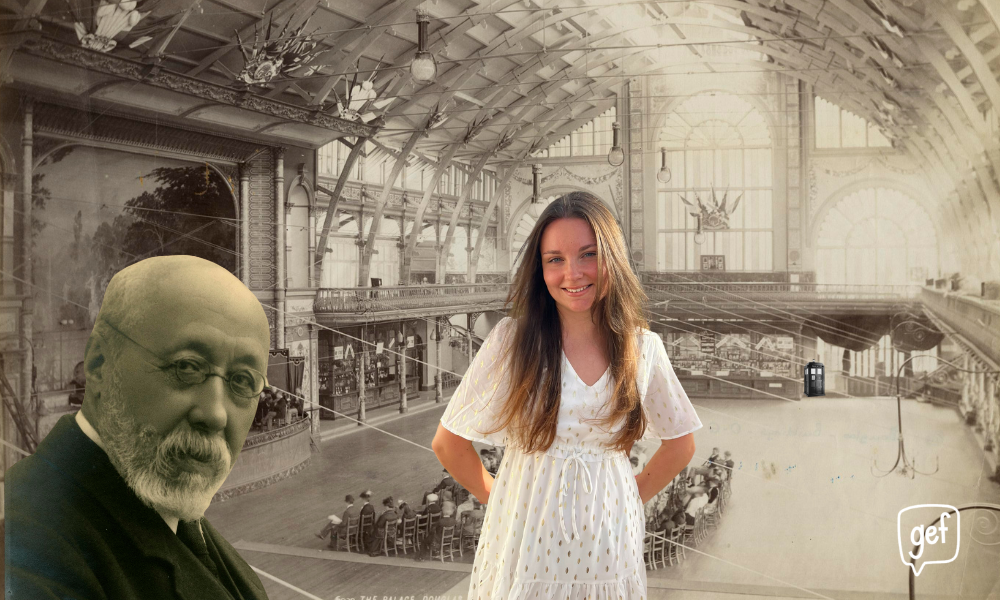
Hello! Welcome back. I can tell that you are raring to read some more about our glorious Manx history. Last time, we saw how Glen Wyllin campsite is dripping in social, industrial and archaeological history spanning over hundreds of years.
Today, we’ll start on the first of a three part series about the history of the Palace.
By ‘The Palace’, yes, I do mean the cinema where you went to watch Barbie. Is the smell of the damp creeping up your nose as you read those words?

The Palace Cinema exterior (Visit Isle of Man)
But, when we consider how old that thing is, the smell starts to make a little bit more sense…
The development of the Palace Entertainment Complex was, quite literally, complex – relying partially on links with the Derby Castle Company Limited (1884-1898). The company, which developed the Derby Castle site at the northern end of Douglas promenade, was originally known as the Derby Castle Hotel and Pleasure Grounds Company (from one tongue twister to another).
The latter, a private company, was founded in 1878 by Alfred N. Laughton (1828-1911) – a lawyer from Yorkshire and long-term Douglas resident. It consisted of six businessmen keen to compete in the tourist industry by turning Derby Castle into a hotel and creating a pleasure park on the grounds.

Derby Castle Hotel and Pleasure Grounds, c. late 19th century (iMuseum)
The tourism industry was growing rapidly. Laughton decided to turn the company into a public one, with 90 other businessmen, forming the Derby Castle Company Ltd in 1884.
One of the original six partners alongside Laughton was John Archibald Brown (1840-1925). John Brown was the son of the founder of the Isle of Man Times (amongst other things), James Brown (big up). John followed in his father’s footsteps as newspaper editor of Isle of Man Times and a tourist property developer.

John A. Brown, c. 1920 (iMuseum)
His father, James, was born in Liverpool in 1815 and was the son of a freed slave. James campaigned for reform to the island’s governmental system, such as a popularly elected House of Keys. His son took the baton for reform from his father, with a passion for developing the island’s tourist industry.
Anyway – when the Derby Castle Co Ltd was formed, Brown decided to branch out on his own. At the time, he was Chairman of the Manx Syndicate – which had acquired the Castle Mona estate. This land would provide Brown the building blocks for the Palace Entertainment Complex.
The Complex began with the breathtaking Palace Ballroom. It opened in 1889, and at the time, it boasted having the biggest ballroom in Europe (not that size matters, of course…).

The Palace Ballroom Interior, c. late 19th to early 20th century (iMuseum)
This was a monumental addition to the island, as it directly contested the tourist facilities of rival seaside resort, Blackpool – which had a ballroom and similar complex setup in the Winter Gardens. By 1893, the Palace had also opened its Opera House – and the Coliseum entertainment complex was added in 1913, which now houses the Palace Cinema.
This quote from 1900 beautifully describes the ‘Palace of Delight’ in its early days:
“…an immense pavilion, of light, but extremely elegant appearance, capable of holding 10,000 persons…a dancing floor large enough to receive 4,000 couples at one time…In this monstre pavilion…adjoining the great pavilion, and connected with it by a covered promenade, is the Opera House; a well arranged theatre, holding some 1,500 persons…offering a wide choice of amusement at one time to the patrons of The Palace.”

The Palace Ballroom and ‘Monstre Pavillion’ pictured in the 20th century, before the construction of the Palace Coliseum in 1913 (iMuseum)
However… in 1898, some of the competing Douglas entertainment companies merged into The Palace and Derby Castle Company Ltd (…it’s never ending!). You’ll be pleased to hear that the group remained under this name until 1964, when the tourist industry began to decline (but we’ll get to that another day).
What caused the merger? Well, competition was becoming so fierce amongst the island’s entertainment businesses (with numerous Douglas venues including the Derby Castle, Palace Ballroom, Marina Pavilion (later the Gaiety Theatre) and Falcon Cliff) that the value of Derby Castle Hotel and Pleasure Grounds Co halved. It was decided that a merger of the entertainment companies was necessary if the island’s tourist industry wanted to survive (serious stuff!).

The Palace Ballroom interior, c. late 19th century (iMuseum)
Under the leadership of John Brown, the merger consisted of Derby Castle, the Palace Ballroom, Marina Pavilion and Falcon Cliff, forming the Palace and Derby Castle Company Ltd – setting up the Palace complex for its heyday in time the great tourism boom into the 20th century.
Tune in next time to find out more about the Palace in the tourism boom, and how it was further developed to provide entertainment for the 617,000 tourists that came to the island in 1913.


50 Years, Three Generations And Thousands of Windows

Josh Secures £300k Backing For Gaming Venture

Review: ‘Easily Tom Holland’s Best Outing As Spider-Man’

New Hotel Plan for Peel

You must be logged in to post a comment.