
Community
Where we Remember Them
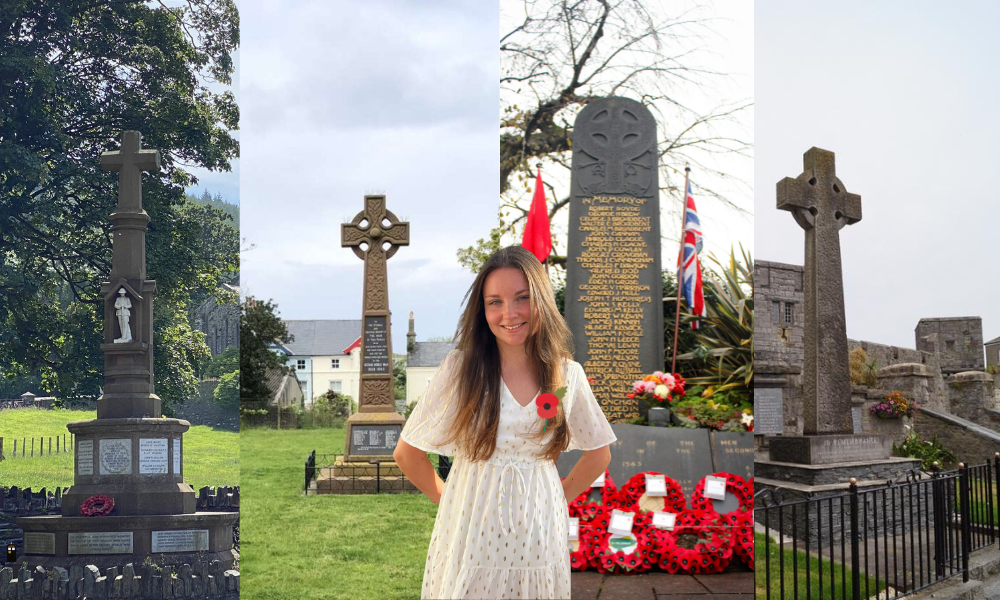
It goes without saying that war memorials are an essential aspect of Remembrance Sunday.
But we see our memorials everyday – whether you’re driving through Onchan or walking along the prom. So, in keeping with our theme of ‘everyday Manx history’, in honour of this Armistice Day, those who lost their lives and the veterans we know and love – I want to tell you about the history of some of our familiar Manx memorials.

Terry Moore, HM Armed Forces Veteran, on Remembrance Sunday 2022. Photo by Luke Phair
Like the UK, the island reacted to the loss of many of its men by erecting memorials to the war dead of WW1 – as a symbol of the shared grief of the community. These memorials were generally unveiled from 1920 onwards. Most were associated with the various parish churches and varied in design from crosses (usually Celtic) to wall tablets.
Onchan War Memorial

Onchan War Memorial Photo by Luke Phair
Onchan war memorial was unveiled on Sunday 16 November 1924. The memorial stone was designed by the famous Manx artist and designer, Arhibald Knox – and carved by T. S. Quayle, a monumental mason of Douglas, and the architect and sculptor for the plaques added to the memorial to commemorate World War Two.
Onchan war memorial is a slab of Irish limestone. Alongside the names of WW1 soldiers, the design features a wheel cross on the front, which is very similar to a Celtic cross in the porch of St Peter’s church, also in Onchan. The rear of the memorial stone shows the outline of another cross, which is believed to be based on Thurith’s (AKA Thorid or Thorith) Cross, also housed in the porch of St Peter’s church.

‘Runic Cross Onchan’ (Thurith’s Cross), iMuseum.
Below the cross, three stone tablets are set side-by-side with the WW2 names and additional, smaller, panels for Northern Ireland and Gulf Conflict casualties.
Mr and Mrs Maltby Broadbent of Eskdale, Groudle, were chosen to unveil the memorial in 1924. The couple lost three sons in the First World War and, understandably, it was said that “…the effect of these blows was never really lost”. Many thought that it was fitting that the couple unveil the memorial, where the names of their sons now forever lay.

Unveiling of Onchan War Memorial by Mr and Mrs Maltby Broadbent in 1924
The Onchan war memorial was moved in 1982, as part of a road widening scheme – which clearly didn’t make much difference to the traffic – to its current location.

Drawing showing the plans to move Onchan war memorial.
Lezayre Parish War Memorial
Lezayre Parish war memorial is in quite an obvious location up north, but might be easily overlooked if you are zooming down Lezayre road (we see you).
It is situated at the junction of the main Ramsey to Sulby road and the Churchtown Loop Road and stands on part of the Farrant Ballakillingan estate.

Lezayre Parish war memorial
A very striking memorial (which will have you thinking, HOW did I miss that?!), it takes the form of a red sandstone cross on an octagonal pillar, mounted on octagonal red sandstone bases. The sandstone is from Bankend Quarries, Cumbria. White marble plaques are affixed to bases.
On a ledge at the front of the pillar, there is a white marble statue of a soldier. One of the most telling ways to see he is a WW1 soldier is his ‘Brodie’ helmet. In September 1915, a design patented by John Brodie was selected as the British Army’s standard head protection. The design meant the helmet could be cut from a single sheet of steel, and then pressed to form a ‘soup bowl’ shape. This made the helmet stronger, and easier to produce.

Brodie pattern steel helmet from 1916.
The memorial was unveiled on Wednesday 23 May 1923 by the Lieutenant Governor. The unveiling of the WW2 commemorative tablets occurred on Sunday 23 September 1951 by the Lieutenant Governor, and the Guard of Honour was performed by the Royal Air Force, Jurby.
The memorial was designed by Ewart Crellin and made by Mr Edward Christian, sculptor from Ramsey.
Castletown War Memorial
Castletown war memorial, which is central to the main square, was unveiled in August 1923 by the Lieutenant Governor (there is a theme here). It was designed by Corrin & Son and sculpted by two local Castletown firms of Mr C. Cubbon and Mr S. Killey, who were monumental masons. The stone is Manx – hurrah! – and came from W. Kissack’s limestone quarry in Scarlett.

Castletown war memorial, Imperial War Museum
The Isle of Man Examiner reported on the unveiling of the memorial: ‘Castletown contributed in an especial degree, in proportion to its population, towards the defence of the Empire [during WW1]…one street having as many as 57 men in the army, navy and mercantile marine, and consequently its Roll of Honour, it’s contribution of final sacrifice, has been remarkably heavy…Seventy seven names are inscribed…’
The mention of fighting in defence of the empire is an interesting insight into how the Manx at this time viewed the British Empire – which is generally thought to have reached its height in 1922. It is also clear from the newspaper report how deeply Castletown felt the losses of WW1.
Peel Peace and Reconciliation Garden
Peel’s war memorial is located in the grounds of Peel Cathedral, in the peace and reconciliation garden.

Peel Peace and Reconciliation Garden, cathedralgardens.im
The memorial itself is the earliest to be unveiled of those we are looking into here, on 20 April 1922. Originally, it commemorated the 101 local men who fell during WW1, but has since been adapted to include 25 men in WW2 and one lost to the conflict in Afghanistan (2001-2014).
The design features a tall Celtic style wheel cross of Woolton sandstone with tapering shaft, decorated with carved Celtic knotwork, square plinth and two stepped sandstone base surrounded by low steel railings on a slate base.
The cross originally stood on a raised grass mound, with steps on the northern approach, but an on-going project to create a unique series of interactive gardens around the Cathedral has seen the cross incorporated into the peace and reconciliation garden. Within the garden, the cross forms the gnomon of a sundial, and a line of stones in the now level lawn leads off from the north-west corner of its base, poignantly marking the position of the winter sun at the 11th hour of the 11th day of the 11th month.
Douglas Borough War Memorial
The war memorial on Douglas prom is probably the most striking of all, mostly due to its immense height, blinding you when you look up to the top of it and receive an eyeful of sunshine (or, more likely, an eyeful of cloud).

Unveiling of the Douglas War Memorial, iMuseum
The memorial was unveiled by Lord Derby on 29 May 1924. There are approximately 867 names listed alphabetically, to men of WW1 on the higher plaques, WW2 lower down, and Manx casualties of the Korean War (1950-53) and the Aden Emergency (1963-67) on attached bronze plaques.
Similar to the memorial at Lezayre, we see a soldier adorning the memorial. We can tell he is a WW1 soldier, from what he is wearing. There is the recognisable Brodie helmet, but also Puttees – long strips of khaki wool that were wrapped tightly around the lower leg, from the ankle to the knee, providing extra support and protection for the soldiers’ legs, as well as helping to prevent trench foot – an affliction common among troops deployed in muddy trenches.

Around two million men found themselves in the khaki uniform of the British Army by 1918. The puttee, worn as a binding around the shins, was one of its most distinctive features.
On the west face of the memorial there is a laurel wreath above the main inscription, and a gold cross near the top of the column. On the east face there is a cross in stonework near the top of the column, corresponding with the gold cross on the west face. Originally, four flowers in bronze were provided on each face – alas – two were removed due to damage on the east face and one was broken off the north face.
The architect was Ewart Crellin of Douglas and the sculptor was Harry Hemms & Sons of Exeter and T. Quayle of Douglas.
‘They shall grow not old, as we that are left grow old; Age shall not weary them, nor the years condemn. At the going down of the sun and in the morning We will remember them.’ – Laurence Binyon


50 Years, Three Generations And Thousands of Windows

Josh Secures £300k Backing For Gaming Venture

Review: ‘Easily Tom Holland’s Best Outing As Spider-Man’

New Hotel Plan for Peel

You must be logged in to post a comment.