
Community
Much More Than a Campsite
Abby is a student on UCM’s History and Heritage degree course
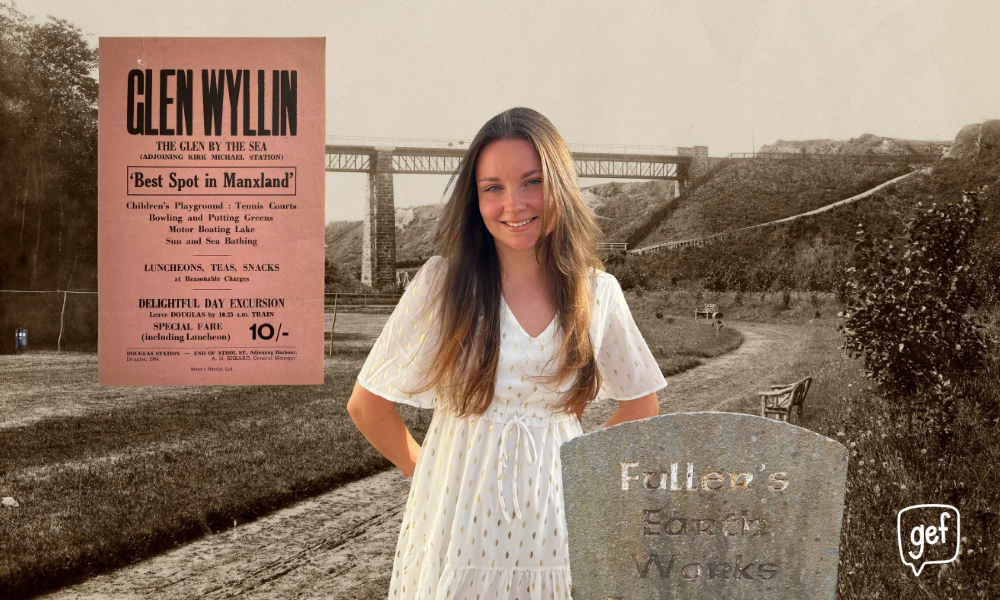
Last time you heard from me, I told you all about my experience as a student on UCM’s History and Heritage degree course. Now, I am going to attempt to show you that I wasn’t making it up, and that I actually have learnt some history over the past two years…
Have you ever been walking, driving, cycling – or indeed, through any other form of movement – and noticed something that made you think, ‘what the heck is that?’?
Assuming that your answer is ‘yes’ because I’m a bit damned if it’s ‘no’ – whether it was a sign, building, ruin or plaque, I want to bring some of this ‘everyday’ history to you.
Today, we will look at some of Glen Wyllin’s history. Yep, the campsite.

Glen Wyllin is much more than a mere campsite. It has an intriguing history that might not be obvious whilst you’re cooking your barbeque on the annual camping trip.This is partly because Glen Wyllin is much larger – and older – than we might assume. The glen’s geography suggests it was cut out of glacial drift, and in 1894, it was reported by the Isle of Man Times that Neolithic flints were found on the site – rudely showing its age.

Island Environment map showing the lower, middle and upper sections of Glen Wyllin and its conservation areas.
The map above shows that the campsite and beach only span across the lower section of the glen. The upper glen includes Cooildarry Glen & Reserve – and Glen Wyllin village is in the middle section. Together, this constitutes Glen Wyllin, which is a Manx National Glen and Conservation Area – due to its special architectural and historic interest.
For example, in Cooildarry, you might stumble across the ruins of Ballakinag Mill. This mill has a long history milling various things, and is thought to be linked to Borodall Mill – which was listed in the 1511-1515 Manorial Roll. Borodall was also the former name of the glen.
The origins of Borodall are ancient. The word itself comes from the Scandinavian for ‘fort’ – linking to an ancient fort that was in the glen, believed to house the Kirk Michael night’s watch (not to be confused with that in Game of Thrones).
Ballakinag Mill was also associated with another name: Fuller’s Earth Works. Set up by Mr A. E. Grundy, who bought Glen Wyllin in the early 1900s – Ballakinag Mill was adapted to work with ‘fuller’s earth’ – which was extracted from the glen to make a valuable material in textile processing and an inert material in artillery shells. A small railway took trucks of wet earth to the mill, which were placed on a large, heated plate and dried out, before being bagged for shipment. This continued until just before World War One.
There were five notable mills situated across Glen Wyllin, but aside from Glen Wyllin Mill (now a house in the village) Ballakinag is seemingly the only one remaining in ruin. There were two mills located by the sea, Corjeag’s Mill and a Flax Mill, which fell victim to coastal erosion – and Moaney Mollagh (meaning ‘Turbary Rough’ – don’t ask me), a dyeing and carding mill, which went to ruin in 1869.

Glen Wyllin Mill, also known as ‘Harry’s Mill’ after the miller Harry Faragher, c. early 1900s. Corn was predominantly milled here. Unknown photographer, Manx National Heritage Library and Archives (MNHL).
What else went on in Glen Wyllin, aside from milling?
In the late 1880s, Manx MHKs, Robert Cowley and John Cowell, formed a syndicate to capitalise on the growing tourism industry on the island. They owned Ballacregga Estate, in the glen – thus opening the Glen Wyllin Pleasure Grounds in 1890. But their efforts were short lived, as the two men had to sell the land following the infamous Dumbell’s Bank Crash in 1900, to Mr Grundy.
Mr Grundy had neither use nor interest in the 22 acres of Pleasure Grounds, being preoccupied with his mill – and subsequently sold the Ballacregga Estate to Mr E. H. Corkill – who, alongside his sister-in-law, Emily Kinvig, revived the Pleasure Grounds in 1907.

Glen Wyllin Pleasure Grounds, c. 1930s. Unknown photographer, (iMuseum), PG/5673/1.
In 1935, the grounds were sold to the Isle of Man Railway Company. They ran the Pleasure Grounds successfully until the beginning of World War Two – remodelling the boating lake and incorporating the railway. The two large pillars halfway down the campsite now are the former supports of the viaduct.

Early image of the train over Glen Wyllin Viaduct. Unknown photographer, courtesy of Dave Evans.
An abundance of leftover tickets and posters give us some insight into what the Pleasure Grounds had to offer. For example, a days’ excursion might have included tennis; ‘duck, paddle or row boating’; playing on the bowling or putting greens; sunbathing in a deck chair on the beach; playing in the park; going on a motorboat or joining in with the music, singing and dancing. There was an abundance of railway packages families could purchase to spend the day at the Pleasure Park.
The Pleasure Grounds resumed business after WW2, until the Northern Railway Line ceased and tourism declined, closing in 1965. A ‘tented campsite’ was first approved on the site by Tynwald in 1979, which is familiar to us today.
So, next time you’re in the Glen – for whatever reason – you’ll be able to tell everyone there that it used to be the ‘Best spot in Manxland’ – and you can collectively consider, ‘what happened?’. You’re welcome.

Poster from 1964, dubbing Glen Wyllin as ‘the best spot in Manxland’. Photo by AFW (poster belonged to my grandad)


50 Years, Three Generations And Thousands of Windows

Josh Secures £300k Backing For Gaming Venture

Review: ‘Easily Tom Holland’s Best Outing As Spider-Man’

New Hotel Plan for Peel

You must be logged in to post a comment.