
Entertainment
Curl Up with Gef’s Top Feminist TV Watches & Listens
Put the big light on and feast your eyes on one these
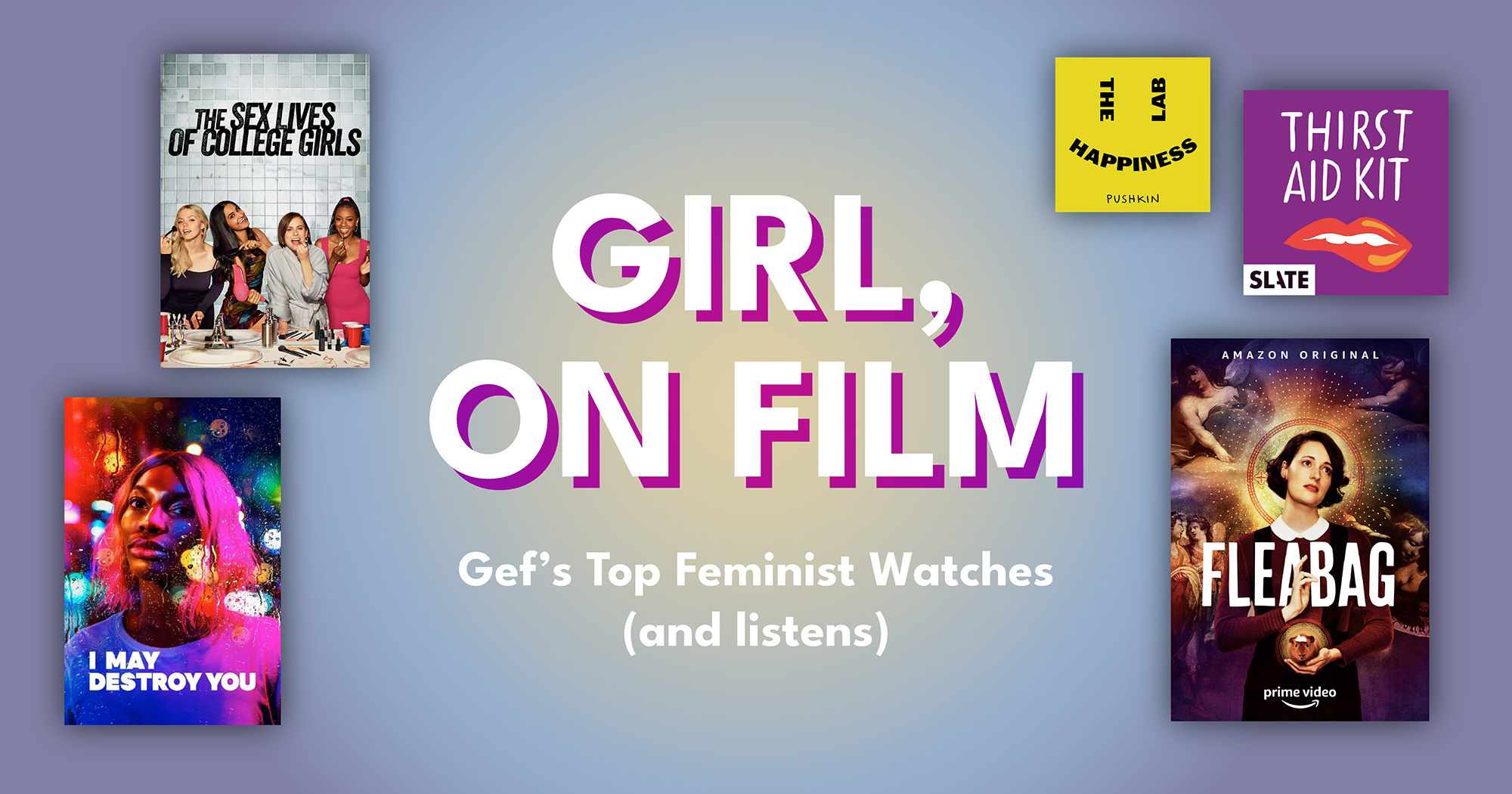
Representation in TV and film is slowly expanding to FINALLY show female characters as more rounded, actual human beings rather than mere 2-dimensional tropes used as tools to meet the needs of male-driven storylines. Tropes like the mum, the mean girl, the nerdy awkward girl, the wise grandmother, the bitch, the sweet/innocent girl whose virtue is ripe for the taking by the right floppy-haired blue-eyed boy, the drunk aunt, the crazy ex-girlfriend, the evil queen, the damsel in distress, the eye candy, etc.
There are A LOT of different kinds of women in the world and only a fraction are seen in film. And those lucky ones deemed to be ‘the norm’ are only represented accurately a fraction of the time. But. At last, we are getting to a point where we’re seeing more of our messy, multi-layered selves on screen. Finally, the world is getting to know that women can be and feel more than two things at once. That women have aspirations outside of anything to do with finding or helping a man. That women have sexual desires that don’t simply revolve around the needs of men. And that, yes, we actually do use the toilet. Our body doesn’t just absorb stuff. We’d all die of internal poisoning.
Seeing representations of ourselves on screens, be they silver or otherwise, validates us. It can make us feel seen, heard, and understood on a mainstream level. It means society has acknowledged our presence and accepted it enough to show it to the rest of the world, which is a comforting notion to those who rarely see themselves in mainstream media. But there’s still a long way to go with accurate representation in cinema and TV that’s sincere and not just used to tick a box to make shows seem more diverse. Especially for women and girls of colour, women who are part of the LGBTQI+ community, and those who aren’t able-bodied. A young girl who needs a wheelchair will rarely see herself depicted in TV series or film, but if there is a character that does use a wheelchair, it’s likely to be the main point of the character. She’ll be displayed as ‘wheelchair girl’ and that will be her main identity.
But small steps are being taken in the right direction. And many of those small steps are being taken by female writers and directors who have acknowledged that the world, and humans, are not simply good or bad, they’re a mix of everything. These women are holding up a mirror to society and showing us more real female characters. Characters who are a tapestry of contradictions: Beautiful and ugly, good and bad, selfish and kind, confusing and basic, sexy, and sloppy – all without repercussions. (Many films spotlighting a female character who breaks the status quo of ‘caring woman who’s just happy to help’ or who is deemed to be ‘too much’ in herself, her wants or her needs ends up punished in some way. Or dead. It’s a trope harking back to the good old days when Eve didn’t do what she was told and snagged that apple, dooming all of humanity in the process. I’d have done the same as Eve. Love a good apple).
So, here is Gef’s list of top watches to continue our celebration of 2024’s International Women’s Day and beyond. Grab some popcorn and a bucketful of giant Toblerones, dim the lights, and get cosy.

Fleabag
If I could hang out with a celebrity, I wouldn’t choose Phoebe Waller-Bridge – the writer and main actor in Fleabag. I admire her too much and have placed her on a ridiculously high pedestal so would be crushed if I found out something terrible like she doesn’t say thank you to waiters. It’s too high a risk.
Phoebe Waller-Bridge’s ‘Fleabag’ started as a one-person play and has been adapted into a 2 season TV series. The first time I watched it knocked my socks off. I hadn’t seen anything so honest, raw, and hilariously relatable. It made me laugh out loud, cry indulgently, and turned on in equal measure. Waller-Bridge takes any stale cliche of what it is to be a woman on screen and twists it into something simultaneously difficult to comprehend and completely understandable. We even see her use the toilet. SHOCK. She talks directly to the camera in-between interacting with other characters as though you, the viewer, are her imaginary friend, and takes you on a journey during which you love, hate, pity, and root for her at different points.
In short though, it’s about a dry-witted woman with zero filter, known only as Fleabag, as she tries to figure out life, family, and love in London while trying to cope with tragic loss. Episodes are on BBC iPlayer and are roughly 20 minutes long. If you haven’t watched, I can’t express how much I want you to. If you don’t, I’ll watch it again for you.

I May Destroy You
Where Fleabag knocked my socks off, ‘I May Destroy You’ knocked me for six. It’s an incredibly powerful series and important as many people watch it as possible. I’ll have a film night, you can all come round and watch it at mine from beginning to end… Try not to picture the eye clamp scene from ‘A Clockwork Orange’ when I say that. I have some but I won’t use them on you. Unless I have to.
‘I May Destroy You’ is written by Michaela Coel, who also stars as the main character, Arabella; another funny, messy character with dry wit. The plot follows her as she deals with trauma after being drugged and raped on a night out. It sounds heavy because it is, as it needs to be. Coel lays bare the different phases and repercussions of trauma in an infuriating, shocking, exasperating chain of events, with added dashes of witty humour that make the heavier aspects even more heart-breaking.
It forces the audience to look at the grey areas of sexual assault and our attitudes as a society towards it. It also has the most honest and unjudgmental period sex scene I’ve ever watched. Coel is an unabashedly brave writer, showing us some ugly home truths that can be uncomfortable to watch. But
her work is vital. We owe it to her not to turn away but to lean in and take a closer look.

The Sex Lives of College Girls
Both ‘Fleabag’ and ‘I May Destroy You’ are funny but heavy. This, on the other hand, is a lot lighter. Written by Mindy Kaling – likely to be most well known as Kelly from the US Office – ‘The Sex Lives of College Girls’ follows four girls from different backgrounds – Kimberly, Bela, Leighton, and Whitney – who end up living together in their first year of uni. The characters and supporting cast are laugh-out-loud funny. Each goes through their own personal struggle ranging from money and class issues, being a closeted lesbian, sexual liberation, an interracial affair with a teacher, being a minority both ethnically and gender-wise in an ‘old boys’ comedy writing club, the list goes on.
It deals with each struggle with humour and compassion, not shying away from the ugly parts, and leaves you feeling all warm and fuzzy inside at the end of each 20-minute episode. While you may only be able to handle a couple of episodes at a time of ‘I May Destroy You’ before needing to take a quick break to re-evaluate your entire being and society as a whole, ‘The Sex Lives of College Girls’ will take up your entire afternoon without you even realising. It’s so bingeable you’ll find yourself at the end not knowing what to do with yourself but feeling good all the same.
A quick add on for the podcast enthusiasts among you. Here are a couple fabulously female led ones to
bend your ear to.

Thirst Aid Kit
This podcast is like eavesdropping on conversations that are a staple of classic girly sleepovers. It’s funny, warm, and all about celebrity lust and crushes. Journalist Bim Adewunmi and writer Nichole Perkins host it. Together, they strip away the shame surrounding female sexual desire and speak freely about Hollywood stars they’d be keen to spend the night with. It’s refreshing and liberating in equal measure and will make you feel just a little bit naughty while listening to it while out in public.
 The Happiness Lab
For the psychology enthusiasts among you. It’s hosted by Yale psychology professor Dr. Laurie Santos who delves into the science of happiness. This podcast, along with 16.75 gallons of ice cream, got me through 2 weeks of pre-op isolation during Covid. Every episode is like getting a comforting hug from someone who simultaneously whispers interesting but easy-to-understand information into your ear. (She doesn’t actually whisper. It’s ASMR).
Start at episode 1 and work your way through. You’ll be gleefully skipping down Duke Street blinding people with the beams of joy radiating from you in no time.
Though these suggestions have been picked for Gef’s continuing celebration of International Women’s Day, I hope they can be as enlightening as they are entertaining for you regardless of your gender.


50 Years, Three Generations And Thousands of Windows

Josh Secures £300k Backing For Gaming Venture

Review: ‘Easily Tom Holland’s Best Outing As Spider-Man’

New Hotel Plan for Peel

You must be logged in to post a comment.