
Entertainment
From Douglas With Love
We have reached the point in our timeline where some of us may well be feeling nostalgic
You have made it to the grand finale of our series on the history of The Palace – and it’s all going on in part three.
We have reached the point in our timeline where some of us may well be feeling nostalgic. Not pointing any fingers. We all love a bit of nostalgia, don’t we?
Little disclaimer before we start: this is a huge area of the Palace’s history to cover. Many of you will have amazing memories that go far beyond what I have been able to research here. I have done my best to cram as much in as possible, but obviously I can never quite get everything. So, please do share your memories/photos about this time period for the Palace, too!
1940s
After the major success of the Palace during the tourism boom we looked into last time, it’s fair to say that World War Two soon put a damper on things.
In December 1940, the Palace grounds along with those of the Derby Castle and Gaiety Theatre were requisitioned due to the outbreak of war.
It was used as an area where materials such as wool were stored and sorted by organisations like the Red Cross, but also still seemingly provided entertainment. The Manx Music Festival took place in 1940, and the Carnival Ball in 1942.
Interestingly, an ‘Alien’s Concert’ was supposed to be held at the Palace Coliseum in 1940, by German and Italian internees to raise funds for Noble’s Hospital. But, growing opposition on-island to entertainment being provided by internees put a halt to the concert.

Headline in the Mona’s Herald, 17 September 1940. iMuseum newspapers.
Things did not take too long to get back on track after the war, and in June 1946 ‘A scene reminiscent of pre-war mid-summer evenings was witnessed at the Palace Ballroom’, with around 2,000 people attending.
1950s
The post-war vibes were certainly good ones.
The International Old Time Dance Festival was a major event during the 1950s taking place in the Palace Ballroom, lasting for one week. A 1959 programme for the event referred to the island as ‘paradise isle’, and a tourist guide from the same year advertising the event commented: “No other British resort provides such magnificent dance orchestras and wonderful dance halls as Douglas…”.

David and Catherine Hughes at the dance championships, Palace Ballroom, c.1957. ‘Ballroom Archive’, FaceBook. [https://www.facebook.com/ballroomarchive/posts/at-the-isle-of-man-dance-championships-palace-ballroom-douglas-circa-1957-david-/2587143414857758/]

A view from the bandstand in the Palace Coliseum Gardens at the Theatrical Gala, roughly where The Palace Hotel stands today, 1957. iMuseum.
1960s
You already know it was all about having a good time in the 60s – and the Palace did not disappoint.
Despite the general agreement that tourism on the Isle of Man began to decline from the 60s, the Palace Lido remained vastly popular, and put on many tourist attracting events.
One of the most intriguing was the Palace Ice Show in the 60s, also referred to as a ‘Carnival of Ice’. Throughout the summer season, in the Coliseum, the Palace would provide the entertainment which we might compare to Disney on Ice. World and British Championship skaters would perform in the elaborate shows.

Jacqueline Harbord, World and British skating Champion, and dance partner at the Palace Ice Show, 1961. iMuseum.
The Rolling Stones came to play twice at the Palace, first in 1964 and again in ‘65. So popular was the event in 1965, a ‘special ship’ had to be organised to make sure all of the tourists could get to the Palace to watch it.
According to an article published in Holiday News in September 1965, the Rolling Stones performed their first show at a ballroom venue for the whole of that year when they came to the Palace. This was because of security reasons – prompting a police dog to be up on the stage with the Stones.

The Rolling Stones on stage at the Palace. iMuseum.
The Palace Coliseum and entrance were demolished in 1965 to make room for the Palace Hotel and Casino (the second licenced public casino on the island after the Castle Mona). This was
the beginning of a bit of a ‘face lift’ (according to Holiday News in 1966) for the Palace, with the ballroom being swathed from floor to ceiling in ‘sugar-candy colours of gold, pink and green’ cloth, making it an equipped cabaret theatre prime for ‘high-tech laser discos’.

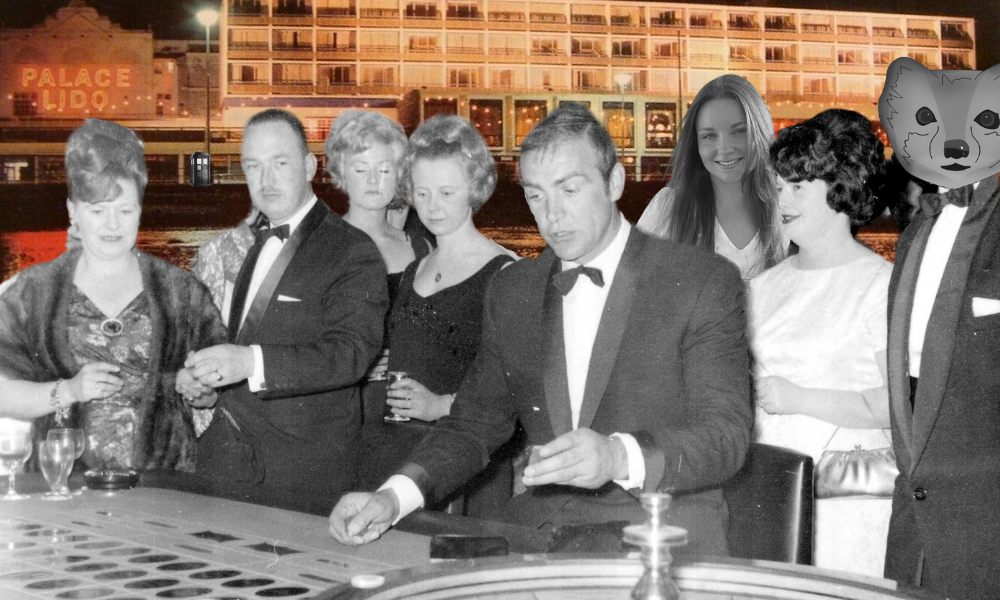
In May 1966, James Bond, in the form of Sean Connery, flew to the island to officially open the Palace Casino. He did so in style, taking the first spin of a roulette wheel.

Sean Connery spinning the roulette wheel, May 1966. Manx National Heritage.
It was towards the late 60s that the Ballroom began to become known as the Palace Lido, finalising its transformation.

The Palace Lido and Casino. FaceBook, Dave Evans
There were also many must-see bands performing at the Lido in the 60s. To name a few: The Kinks (‘66); and in star-studded 1967, The Who, Pink Floyd and Cream. Welsh legend Tom Jones also made an appearance in 1966… as a Cabaret act!
1970s
The concept of the Lido and Casino were in full swing going into the 1970s. More big name bands continued to perform, such as Slade and Roxy Music in 1973; Queen (yes!) and Status Quo in 1974; Thin Lizzy for ‘75 and no other than AC/DC in 1976. Clearly this was where all the cool kids were going!

Poster advertising Slade and Roxy Music playing at the Lido in 1973. FaceBook, Terry Holmes.
1980s
It’s around this time – the 1980s – that my mum and her friends would have come onto the scene (you know who you are).
Characterising a night out at the Lido were the ‘four pint jugs’ of beer, secret snogging balcony which remained from the more sophisticated days of dancing and theatre and – I cannot forget to mention – the apparently delightfully sticky floor from all the spilt four pinters. I have heard it from several sources, so it must be true.

It is no wonder the Palace Lido had a sticky floor. FaceBook, Lightman Mike.
The music scene did not falter, with Dr Feelgood and Motorhead coming to play at the Lido during the 80s, along with Girlschool – one of the longest running all-female rock bands – amongst others.
For the year of 1986, the Palace Lido was also awarded ‘Discotheque of the Year’ in the United Kingdom.
1990s
Sadly, our era ends with a not-so happily ever after for the Palace (as you might have guessed, if you have ever walked past it).
But it didn’t go out without a bang. Many of you may remember the infamous TT Carnival that took place at the Lido until 1990. That is all I am going to say about that… what happened in the Lido, can stay in the Lido at this point.

Queues like this were a regular sight to get into the Lido for the TT Carnival. Facebook, Kathy Atkinson
In 1990, The Palace Lido was registered as a protected building, due to its architectural value.
Yet, it was demolished four years later to ‘make room’ for an extension to the casino – which materialised as that shoddy old car park.
The building was submitted to be de-registered in 1991 after an appeal claiming it did not fit the criteria of a registered building, stating that it was not a particularly architecturally significant building…
This claim seems rather unfair when we think back to our beautiful ballroom and its historical journey beginning in the 1880s. It might be suggested that the motivating reason for this change of tune was the minimum of £1.2 million that needed spending on the building to maintain it.
The Palace Lido was consequently de-registered as a protected building and demolished in 1994, leaving only our cinema building from the original complex. RIP! 🙁

Demolition of the Lido in a newspaper clipping. FaceBook, Ryan Kelly.
I hope you have enjoyed reading this three part series about the Palace, and remember to show that (really) old cinema some love. Ta ta for now!


50 Years, Three Generations And Thousands of Windows

Josh Secures £300k Backing For Gaming Venture

Review: ‘Easily Tom Holland’s Best Outing As Spider-Man’

New Hotel Plan for Peel

You must be logged in to post a comment.